I write about using AI to build a business that runs without you. Systems, automations, and the freedom that shows up when the work stops depending on you being at the desk. Keynote speaker, creator of The R³ Method™, author, and father of five. I build all of this in the margins of a full life, and I share exactly how. Subscribe and I'll show you how to get your time back, then use it on the stuff that actually matters.
I started a second newsletter and ChatGPT noticed
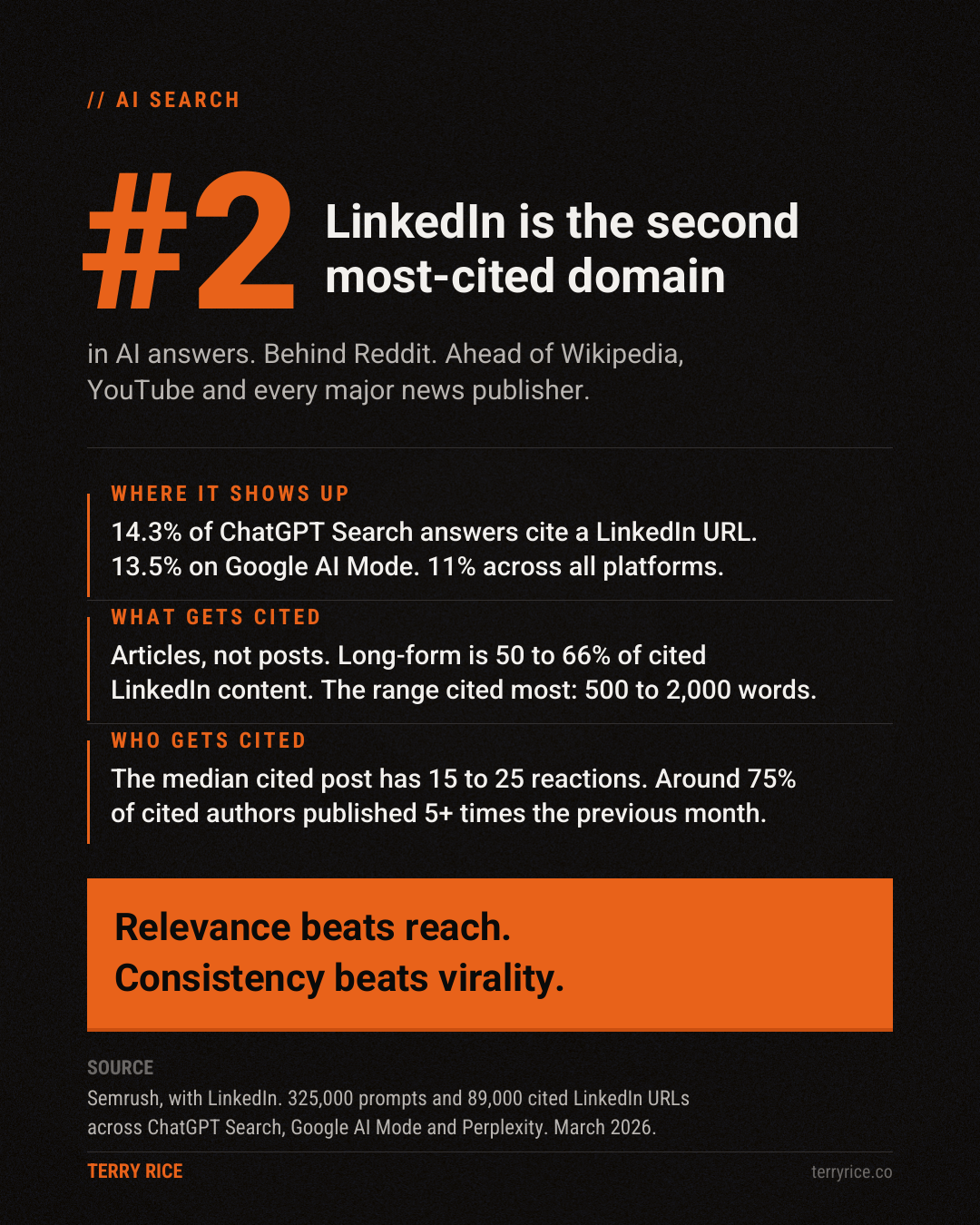
A few weeks ago I started a second newsletter on LinkedIn. It's called Better Problems, and it runs on one question: is this hard because it's worth it, or hard because it's wrong? Yes, part of the reason I'm telling you is that I'd like you to read it. The more useful part is why I started it, because it wasn't a hunch. It was a test with real research behind it, and the research is worth your ten minutes even if you never write a word on LinkedIn. LinkedIn does the launch for you. Then it keeps doing it. When you publish your first edition, LinkedIn invites your connections and followers to subscribe. That happens once, on the first one, and never again. Three issues in, Better Problems is at 2,196 subscribers. Here's the part almost nobody mentions. It kept climbing after that. Every time someone new follows you, LinkedIn invites them to subscribe automatically. It's adding 40 to 70 a day and most of that has nothing to do with me. Obvious caveat: the launch works in proportion to the following you already have. If you have 300 followers, the spike is 300 people's worth. The compounding still applies, and it starts the day you publish rather than the day you get big. Every issue is a notification instead of a gamble. A regular post goes into the feed and the algorithm decides who sees it. You've felt that. Two posts, same effort, one gets 400 impressions and one gets 40,000. An edition sends a push notification, an in-app alert and an email to every subscriber. It skips the feed entirely. Same platform, completely different distribution. Then there's the reason I actually ran the test. I was leading an AI training on how to get ranked by large language models. One of the other instructors made a point I hadn't considered: LinkedIn is one of the best places to do it, because the models read that content heavily, along with Reddit. Call it SEO for AI. Same idea, different machine reading it. His second point is the one that stuck. A short LinkedIn post gives a model one sentence to work with. A long-form article gives it your actual argument, your terms defined, the reasoning worked all the way through. More surface area, more of an imprint. I had content I'd been sitting on that needed a dedicated home anyway. So I stopped theorising and published. The research says he was right. Semrush ran 325,000 prompts through ChatGPT Search, Google AI Mode and Perplexity and pulled the 89,000 LinkedIn URLs those tools cited back. The study is public and worth reading yourself. LinkedIn came out as the second most-cited domain in AI answers, behind only Reddit and ahead of Wikipedia, YouTube and every major news publisher. It shows up in 14.3% of ChatGPT Search responses. On the long-form question specifically: articles account for 50 to 66% of the cited LinkedIn content, and the length cited most often is 500 to 2,000 words. Feed posts make up 15 to 28%. And the part that should take the pressure off. The median cited post has 15 to 25 reactions. Around 75% of cited authors had published five or more times in the previous month. Relevance and consistency get you cited. Virality does not.
My own version of the test: I searched ChatGPT and Grok for the Hard or Wrong Test. I come up. LinkedIn is the only place I'm writing about that framework at length right now, so I'm giving it the credit. Why that mattered more than it sounds like. The AI visibility is the mechanism. The reason is simpler. I wanted a body of long-form work on the internet about one specific thing. If you ever want to write a book on a topic, or get on a stage to talk about it, both of those want a public record of your thinking on a single subject. Not a general presence. One subject, at length, in one place. Mine is discernment. More on that at the bottom. Here's the part I want you to take. Don't start a newsletter to have a newsletter. Start one if there's a single topic you'd still want your name attached to in three years. If you have that topic, the platform question gets easy. If you don't, no platform fixes it. And give it somewhere to send people. An article is the one place on LinkedIn a link can live that isn't your feed. Mine carries the Hard or Wrong workbook: bit.ly/3RslLwp. That's how a reader turns into an email address instead of an impression. Run the test on it. You might be sitting there thinking this is one more thing to write and you're already behind on the things you write now. Fair. But an article doesn't have to be a new idea, and right now you can't answer whether starting one is hard or wrong for you, because nothing has happened yet. There's no evidence to settle it with, so anything you decide today is a guess wearing a strategy costume. So go make a fact. Take a post from the last 90 days that beat your average and expand it past 500 words, which is where the citations start. Publish it once. The next morning, look at two things: how many people subscribed, and whether writing it felt like something you'd want to do forty more times. If both answers are good, keep going. If they're not, you spent one afternoon and you know. Either way you found out, which beats wondering. And if you want to see the format before you build your own. Three issues is not a track record and I'm not going to pretend it is. But the two newsletters do different jobs, and this one stays home base, so nothing changes here. Better Problems is narrower and it's the same question every week. Some things are hard because they're worth it. Some are hard because they're wrong. They produce identical symptoms, so most people settle it by feeling, which is like using the smoke alarm to work out whether the building is on fire or someone burned toast. What that looks like in practice. Issue one put two situations side by side that felt exactly the same and had opposite correct answers, one to push through and one to stop. Issue two was about the seven seconds you get after an impulse before your brain builds a case against it. Issue three was the side door I used to get into General Assembly after they rejected me twice through the front. Every one ends the same way: name the goal, settle hard or wrong with evidence, name the move.
And if writing in public turns into someone asking you for real help, you should be able to get paid for it without chasing an invoice. That's what EveryExpert is for. Go expand one post. Keep building, P.S. I booked my first paid call on the Hard or Wrong Test this week. Someone deciding whether to start a new company, walking through it question by question. That's the closest I'll get to coaching and I'm glad to see it working. Thirty minutes, on that or on pricing, warm leads, AI systems or brand deals: everyexpert.com/terryrice P.P.S. If you'd rather be on the other side of that call, you can set one up yourself. One thing you're good at, one price, one link: start your EveryExpert profile |
The Real Work: AI Systems
I write about using AI to build a business that runs without you. Systems, automations, and the freedom that shows up when the work stops depending on you being at the desk. Keynote speaker, creator of The R³ Method™, author, and father of five. I build all of this in the margins of a full life, and I share exactly how. Subscribe and I'll show you how to get your time back, then use it on the stuff that actually matters.
This issue is sponsored by Entrepreneur Live. Hey, I'll be speaking at Overcoming Impossible Live on October 23 in Brooklyn, along with Gary Vaynerchuk, Jason Feifer, Megan Thee Stallion, and Robert Irvine. I'll be leading hands-on workshops. If you can, bring your toughest problems in business, and we'll work on a plan together. Details here. Use promo code TERRY and you save $150. And now let's get into it. Last week I launched Send It, my new card game. The launch email had the subject...
Save your seat → Almost everyone I talk to is worried AI is coming for their job. Almost nobody is doing the thing that would make them harder to replace. Not learning another tool. Reps. In rooms. In front of people who can react in real time, where the whole value is that you're standing there and a model isn't. That's the bet I've made, and speaking is the version of it I've chosen. I'm going to tell you what eleven days of that did, then show you the same move applied to your actual job....
Sponsored by EveryExpert People already ask you for advice. EveryExpert makes it a paid, booked call instead of a favour. One thing you're good at, one price, one link. Start your profile → Monday I'm speaking to students at the University at Buffalo, where I went to school. Tuesday I'm on a stage at Adobe, where I worked from 2009 to 2012. I built both talks in six days, with four kids home from summer camp. No notes, no text on any slide. I'm going to show you the talk and then show you...